June 13, 2026
Mock Interview Process for Developers: 2026 Guide
Master the mock interview process for developers with this 2026 guide. Enhance your skills with tools and strategies for success!
Mock Interview Process for Developers: 2026 Guide

The mock interview process for developers is a structured practice cycle that replicates real technical interview conditions, covering coding rounds, system design, behavioral questions, and rubric-based scoring. Industry term: technical interview simulation. Most candidates treat interview prep as passive study. The ones who get offers treat it as active performance training. This guide shows you exactly how to build that training cycle, which tools to use, and how to turn feedback into measurable improvement.
What tools power an effective mock interview process for developers?
The right platform determines whether your practice mirrors a real interview or just feels like answering questions alone. AI-powered tools like Interview Sim, Intervex, and InterviewOps each replicate different parts of the developer interview loop. Choosing the right one depends on which round you need to sharpen.
| Platform | Key Feature | Best For |
|---|---|---|
| Interview Sim | Turn-based AI with pushback on vague answers | Full-loop simulation |
| Intervex | Resume-personalized questions, 6-dimension scoring | Targeted skill gaps |
| InterviewOps | Configurable tracks: coding, system design, behavioral | Multi-round practice |
| AjayLuhach AI Mock Interview | Camera-on recording, AssemblyAI transcription, 1–10 scoring | Realistic pressure reps |

Voice and text answer modes matter more than most candidates realize. Intervex offers configurable countdown timers per question, ranging from 30–300 seconds, plus real-time AI feedback across six dimensions. That timer pressure is what separates useful practice from comfortable practice.
AI-generated questions personalized from your resume and a target job description are a significant upgrade over generic question banks. When the system pulls from your actual experience, the follow-up questions hit closer to what a real panel will ask. Rubric-based scoring, as used by Karat, separates competencies like Code Productivity from Code Correctness and scores observable behaviors such as clarifying requirements and identifying test cases.
Pro Tip: Before your first session, run a five-minute dry run on any platform you choose. Confirm your microphone, camera, and screenshot hotkeys work. Minor technical friction during a real session costs more points than a wrong answer.
How do you run a full developer mock interview session?
A complete software engineering mock interview covers more than one coding problem. It replicates the full interview loop: recruiter screen, technical coding round, system design, behavioral questions, and sometimes a code review or take-home walkthrough. InterviewOps enables configuring each of these tracks precisely within a single session.
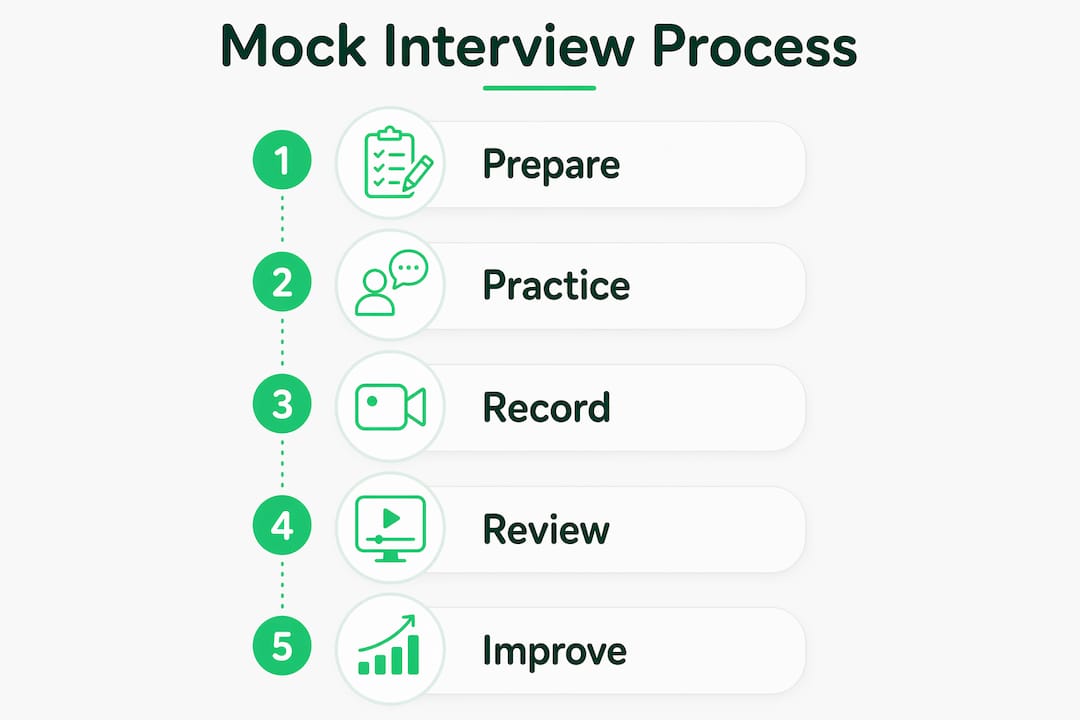
Here is a step-by-step session structure that mirrors what top tech companies actually run:
- Onboarding and setup (5 minutes). Load your resume and the target job description into the platform. This seeds personalized interview questions for developers that reflect your actual background.
- Recruiter screen simulation (10 minutes). Answer background and motivation questions. Practice concise answers under 90 seconds each.
- Coding round (30–45 minutes). Work through one or two algorithm problems with a countdown timer active. Talk while you type. Explain your reasoning out loud before writing a single line of code.
- System design round (20–30 minutes). Sketch architecture, name your data stores, and call out tradeoffs explicitly. Interviewers score the decisions you verbalize, not just the diagram.
- Behavioral round (15 minutes). Use the STAR method: Situation, Task, Action, Result. Prepare three to five stories that cover conflict, failure, and leadership.
- Code review or take-home walkthrough (10 minutes). Walk through a code sample line by line. Identify bugs and explain what you would change and why.
- Post-session rubric evaluation. Separating live interaction from scoring reduces anxiety and produces detailed feedback mapped to specific rubric criteria.
The separation of live session and scoring is not just a comfort feature. It allows the AI to map your transcript evidence to each rubric sub-competency without the pressure of real-time judgment affecting your performance.
Pro Tip: During coding rounds, capture a screenshot of the problem prompt immediately. Platforms like CoderPad track screen interactions, and having the prompt visible as an overlay keeps your narration grounded and specific.
What are the most common mock interview mistakes developers make?
Most candidates fail mock interviews for behavioral reasons, not technical ones. Mock interviews reveal weaknesses invisible in self-study, including communication style, pair-programming behavior, and the ability to verbalize reasoning while solving a problem.
The most frequent mistakes fall into these categories:
- Confusing internal reasoning with observable communication. You know what you are thinking. The interviewer does not. Rubrics score what you say and do, not what you intend. Observable-action rubrics require candidates to produce explicit behaviors: clarifying requirements, stating assumptions, and narrating test cases.
- Skipping tradeoff explanations. Choosing a hash map over a sorted array without explaining why signals shallow thinking. Always name the tradeoff, even when the answer feels obvious.
- Ignoring rubric criteria entirely. Many candidates practice coding but never read the scoring framework. If you do not know what the rubric measures, you cannot optimize for it.
- Focusing only on code correctness. Communication, testing strategy, and problem decomposition each carry separate scores. A correct solution with zero narration often scores lower than a partially correct solution with strong process visibility.
- Skipping timed practice. Solving problems without a timer creates false confidence. Real interviews run on strict time limits, and the cognitive load of the clock changes how you think.
“Candidates often overlook that interviewers score visible artifactual behaviors, such as screen interactions and overlays, as much as code correctness. Rehearsing interaction patterns before the live interview is not optional.” — CoderPad Live Coding Guide 2026
Rehearsing screenshot hotkeys and your talk-while-typing rhythm before a live session prevents minor technical distractions from costing you points that a wrong answer never would. Small frictions compound under pressure.
How do you use mock interview feedback to keep improving?
A single mock session tells you where you stand. A series of sessions with structured retakes tells you whether you are actually improving. The difference is how you use the feedback.
Follow this four-step improvement cycle after every session:
- Review your transcript. Read what you actually said, not what you meant to say. Look for gaps between your intent and your output.
- Map feedback to rubric sub-competencies. Interview Sim’s two-stage scoring process covers technical depth, communication, and problem-solving separately. Identify which dimension dropped your score.
- Build your retake question mix. The most effective retake strategy uses 40% questions from your weak areas, 40% new questions at your current level, and 20% harder questions. AjayLuhach’s AI Mock Interview supports personalized retake scheduling based on your scoring history.
- Set a target interview date and work backward. InterviewOps supports day-by-day preparation schedules. Knowing your deadline forces you to prioritize weak areas over comfortable repetition.
| Improvement Dimension | What to Track | How to Act |
|---|---|---|
| Technical depth | Rubric sub-score per round | Add one harder problem per week |
| Communication | Transcript word count per answer | Practice STAR stories out loud daily |
| Problem-solving | Time to first working solution | Reduce by 10% each session |
| Practical experience signal | Specificity of examples cited | Prepare three concrete project stories |
Progress dashboards and session history logs in platforms like Intervex let you see trends across sessions, not just snapshots. Treating developer interview practice as a training loop with retakes produces measurable improvement. Treating it as a checklist produces false confidence.
Pro Tip: Schedule your mock sessions on the same day of the week and at the same time as your target real interview. Your brain performs better when the context matches.
Key takeaways
The mock interview process for developers works when it combines realistic simulation, rubric-based scoring, and structured retakes into a repeatable improvement cycle.
| Point | Details |
|---|---|
| Use rubric-based scoring | Score observable behaviors like requirement clarification, not inferred intent. |
| Replicate the full interview loop | Cover coding, system design, behavioral, and code review rounds in every session. |
| Separate live session from evaluation | Post-session scoring reduces anxiety and produces more specific, usable feedback. |
| Build a structured retake mix | Combine 40% weak topics, 40% new questions, and 20% harder problems each session. |
| Rehearse platform interactions | Practice screenshot hotkeys and narration rhythm before any live coding interview. |
Why rubric-driven practice changed how i think about interview prep
Most candidates I have worked with treat mock interviews as a confidence check. They do one or two sessions, feel better, and move on. That approach misses the entire point.
The shift that actually moves the needle is treating every session as a data collection event. When I started reviewing transcripts against rubric criteria, I realized how often candidates say the right thing internally and nothing externally. The rubric does not care what you were thinking. It scores what you said and what you did on screen.
AI interviewers that push back on vague answers are more valuable than polite ones precisely because real hiring panels do the same. If your mock interviewer never challenges you, you are not preparing for the actual experience. The discomfort of being pressed for specificity is the training stimulus.
Live coding etiquette is the most underrated preparation area I have seen. Candidates lose points not because their algorithm is wrong but because they went silent for three minutes, failed to narrate a decision, or fumbled a screenshot during a CoderPad session. These are rehearsable skills. You can eliminate them entirely with deliberate practice before the real interview.
The candidates who improve fastest are the ones who treat each retake as a targeted experiment, not a repeat performance. They adjust one variable, run the session, and check the rubric output. That is how you build a full-stack developer interview skill set that holds up under real pressure.
— Noah
Build your interview prep plan with Projects2jobs
If you are serious about technical interview preparation, you need more than a question bank. You need a structured plan built around your actual skill gaps.
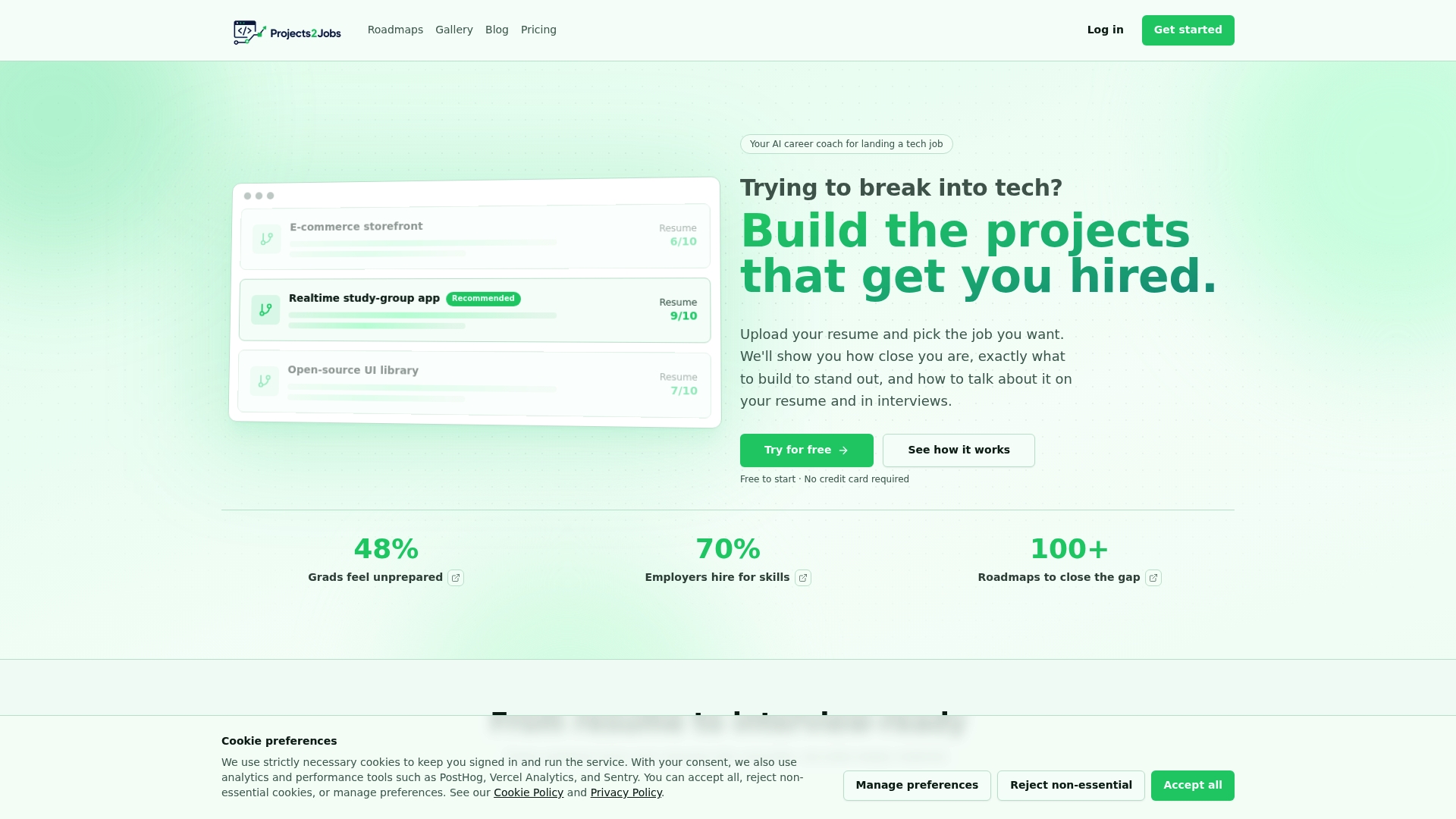
Projects2jobs uses AI to generate personalized project roadmaps based on your resume and target role, so your preparation addresses real weaknesses instead of generic topics. The platform integrates mock interview simulations with resume-based question generation, giving you a direct line from your background to the questions you will actually face. Whether you are targeting a backend, frontend, or full-stack role, the AI Project Roadmap Builder at Projects2jobs maps your path from where you are to where you need to be. Start your structured prep today.
FAQ
What is the mock interview process for developers?
The mock interview process for developers is a structured practice cycle that simulates real technical interview conditions, including coding rounds, system design, behavioral questions, and rubric-based scoring. It is designed to build observable skills and reveal communication gaps before the real interview.
How many mock interviews should i do before a real interview?
There is no fixed number, but iterative practice with structured retakes produces better results than a single session. Use a retake mix of 40% weak areas, 40% new questions, and 20% harder problems until your rubric scores improve consistently across all dimensions.
What is the STAR method in behavioral interviews?
STAR stands for Situation, Task, Action, Result. It is the standard framework for answering behavioral interview questions for developers, giving interviewers a clear, structured narrative tied to observable outcomes.
Why do AI mock interviewers push back on my answers?
AI interviewers challenge vague answers to mirror real hiring panel dynamics. Real interviewers probe for specificity and depth, so practicing under that pressure prepares you to respond clearly when it counts.
What is rubric-based scoring in a technical interview?
Rubric-based scoring evaluates candidates on observable actions rather than inferred intent. Karat’s framework, for example, separates competencies like Code Productivity and Code Correctness, scoring specific behaviors such as clarifying requirements and identifying test cases rather than overall impression.